






Pre-arrival information for your self-guided holiday in France
Self-guided cycling and walking requires individuals to use problem-solving skills, be adaptable and have a keen eye. You should be comfortable with map-reading and the use of a travel app and/or referring to route notes and have a good sense of direction (or be willing to work on improving this!). At times route finding, losing your way and finding it again, or asking locals for help is all part of the adventure. If this is your first time on a self-guided trip, you will certainly get the hang of it after the first couple of days, as do the vast majority of our first-time travellers.
In this document we will provide you as much useful information as possible.
This is essentially an independent holiday, and part of the pleasure is experiencing local life, with its day-to-day challenges. Your trip was designed and is organised entirely by S-Cape. All our staff members speak fluent English and we are always on hand to help out in case of need or difficulty.If you have any questions or problems while travelling, you can contact the office during office hours or the emergency phone that is on 24 hours a day.
Have a great holiday!
Team S-Cape Partners France
| Ambulance / medical assistance / police: | 112 |
|
Local Assistance: • S-Cape Partners France • Emergency mobile |
|
Please be assured that all material provided for route finding is updated regularly, and we provide a 24/7 Bilingual Emergency hotline in the event of any problems. There is a certain level of the unknown that comes with self-guided trips. However, with a methodical approach, potential problems will be avoided. The freedom of a self-guided trip is something that, once experienced, is sought time and time again.
Address and contact details
S-Cape Partners France
55 rue Saint Jacques
24540 MONPAZIER
France
| Office Tel.: | +33 5 53 73 08 61 |
Office hours:
Monday-Friday: 09.00-18.00 hrs.
Problems/complaints during the trip
At S-Cape, we take customer satisfaction very seriously. Complaints about accommodation or any other service booked should be dealt with on the spot, immediately and WHILE you are travelling. We cannot solve such problems once your trip is over, so complaints submitted after the fact will be of little help to you.
Please discuss the problem directly with the service supplier first, in order to give them a chance to solve the problem. If this does not produce the desired result and you feel you have a legitimate complaint which is not being dealt with in the proper manner, kindly contact our office so that we can assist you in the matter. Though we can usually only mediate by phone, we will be happy to help sort out any difficulties to ensure that your stay is a pleasant one.
If you cannot continue your trip
In the unfortunate event you cannot continue the programme due to illness, injury or extreme weather conditions, you should always inform the (next) accommodation as well as your local agent. They will assist you in changing the accommodation scheme if necessary, discussing first the possible extra costs of this change. You will always have to pay for extra costs on the spot and then claim compensation from your travel insurance if possible.
Loss of personal Items
If you lose something or have it stolen and wish to make a claim to your insurance company when you return home, you must report it to the police (Gendarmerie or Police Nationale) when it occurs. The Police will ask you to fill out a form and give you a copy. The vast majority of insurance companies will request a copy of this form when processing your claim. If you lose your passport, this document may be valid for international travel, but you should contact your embassy / consulat.
Accommodation & Meals
Please check your travel documents for a list of the hotels which have been booked for your holiday and the meals included in your programme.
Alternative accommodation
During high season you might be booked into an alternative accommodation, which may not be listed in your route notes. The start or end of the routes may then be slightly altered, so pay close attention at the start and end of the routes. In some cases, we provide extra descriptions to be used when starting from / returning to an alternative accommodation.
In choosing alternative accommodation we have tried to maintain the same standards and quality and, whenever possible, location (in the same town or village), in order to modify the routes as little as possible.
Accommodation list & Check-in
You have been provided with an accommodation list confirming all the services booked for you with the name and addresses of your hotels and other service suppliers.
The official check-in time is typically from 3:00 pm, and sometimes as late as 5:00 pm. Smaller accommodations, like B&Bs, may open later in the afternoon. It is advisable to call a day in advance to inform them of your estimated arrival time.If you plan to arrive before the check-in time, notify the hotel in advance so they can try to prepare your room early. If early check-in is not possible, inquire about leaving your luggage at the hotel. This way, you can take a stroll around the area or relax at a coffee shop, making for a pleasant start to your trip. By the time you return, your room should be ready.
When you check in at an accommodation, you may be asked to show this as proof of confirmation. You will also have to present some form of ID.
REMEMBER to collect your ID before you leave.
Transport
We have done our best to give you the most recent information, but do remember that timetables are subject to change, sometimes without notice. Please check the local timetables before departure, then double-check on arrival. You can also ask the accommodation owners for assistance.
Do not forget to stamp or validate your ticket. Before your departure, your ticket must be stamped / downloaded on your phone. If you haven't had time to stamp or validate, report it quickly to the train controller. If you have chosen the e-ticket service, there is no need to stamp your travel confirmation.
If you are travelling on a Sunday or a national holiday, remember to double-check timetables as fewer services may be available.
Included transfers
S-Cape is concerned about client safety. If your programme includes transfers, please remember to use your safety belt at all times. Most of our local suppliers and taxi drivers collaborate with S-Cape on an on-going basis. They are familiar with our programmes and the safety standards sought by S-Cape. Should you feel at any time that proper safety practices are not being observed, please contact S-Cape and / or your agency.
Late arrivals / delays on Arrival Day
If you have booked a transfer from the airport or train station to your first accommodation and experience considerable delay, please call as soon as possible to warn the transport company or local agent. You’ll find the phone number on your Trip Voucher and/or under the “Organisation” section in your Route Notes or in the travel app.
If you are travelling by car, make sure you have the address or coordinates of your first accommodation, to enter into the travel app (such as Google Maps, Ways) you use for driving.
If you plan to arrive after 18.00 hrs, please inform the accommodation of your estimated arrival time. Smaller accommodations like B&B's might open later in the afternoon. You might want to call them a day in advance to inform them on your estimated time of arrival.
Weather forecast
Check the weather forecast before you set out for the day. You should always carry a fleece/warm clothing in addition to a wind breaker, rain jacket, gloves and a warm cap.
Hot weather
It can get warm in summer. To avoid the danger of heat stroke, you are advised not to do any cycling or walking if temperatures rise above 35º C. Remember that springs may dry up, so remember to carry plenty of drinking water (at least 2 litres per person). Good sun protection is essential (sunscreen, sunglasses, hat).
Caution at the beach
If you are visiting a coastal area, please take care when swimming in the sea. Rogue waves and swift currents may be present any time. Pay close attention to any warning signs along the coast, follow recommendations from local residents and ask hotel staff for more information when necessary.
Dogs
In rural areas you might encounter dogs. Do not panic and continue cycling or walking past the dog, waving your trekking pole if necessary. If the dog persists in bothering you, a more aggressive approach could be required, such as pretending to throw or (only in extreme cases) actually throwing stones.
Hunting
Hunting is quite common in rural areas all over France. Most hunting seasons start in September and continue to April, but the exact dates change every year. If you hear shooting near you, make your presence known to the hunters.
Safety & Arrival time at the end of your day
It is good practice to take a fully charged mobile phone with you every day. You should have the phone switched on, even if you prefer to keep the ringer off.
We recommend saving emergency phone numbers in your mobile phone.
Make sure to check the duration of your route and the local sunset time. If you think you may arrive after 18.00 hrs (or less than 1hr before dark), please inform your accommodation for that evening. The accommodations we work with are familiar with our self-guided programs and, if you do not arrive before sunset, they may start to worry and decide to call for a rescue.
If you are travelling alone in remote areas, please inform the accommodation owner of the route you will be taking and your approximate arrival time.
For your safety, before departure it is ESSENTIAL to:
Know how to send your current location via SMS text message or other messaging system, such as WhatsApp. (To do so, open a new message, select the “Attachment” function and choose “Share my location” - then click on “Accept” to allow your device to access your location.)
National holidays
France has a number of national and local holidays. Banks, shops and government institutions will be closed AND bus/train services may be reduced.
Bank holidays in France:
• 01 January (New Year’s Day)
• Friday before Easter Sunday (Good Friday)
• Easter Sunday and Monday
• 01 May (Labour Day)
• 08 May (Victory in Europe Day)
• Thursday, 39 days after Easter Sunday (Ascension Day)
• Monday after Pentecost (50 days after Easter), observed only in some businesses (Whit Monday)
• 14 July (Bastille Day)
• 15 August (Assumption)
• 1 November (All Saints’ Day)
• 11 November (Armistice Day)
• 25 December (Christmas day)
• 26 December (Boxing day only in Alsace-Lorraine)
Fitness: preparing for your trip
Make certain you are in good health and in sufficiently good physical condition to handle the exertion required by the trip.
The concept behind our trips is the enjoyment of an active holiday, and the fitter you are the more you will enjoy yourself. So we recommend
preparing for this holiday. The best training is to practice what you are going to be doing: walking or cycling uphill, downhill and cross-country (on uneven terrain). Train and build up gradually to avoid causing yourself an injury! Using your gear before departure (boots, day-pack, clothing, etc.) gives familiarity and comfort while on your trip, and helps identify any potential problems.
Nutrition
Your body needs fluids, vitamins, minerals and carbohydrates to work. While walking or cycling, your body needs more of these than it can store. Have a low-fat, regular portion breakfast (such as cereal) every morning and drink plenty of water and fruit juice.
During your walking or cycling route, maintain your body's water level by drinking often; drink before you are thirsty and eat before you are hungry; consume low-fat snacks such as fruit or energy bars; good foods include bananas, oranges, apples, raisins and other dried fruits. It is recommended to carry at least 1.5 / 2 litres per person, and more if it is particularly hot or windy. Avoid eating a big meal during the route.
After the walking or cycling route, continue to hydrate and replace lost energy stores by eating proteins, carbohydrates and sugars.
Travel documents
Personal Identification. You will need a valid passport to travel to France. If you are an EU citizen, you can travel with your national identity card BUT be advised that some international airlines require you to present a passport for international travel.
Non-EU residents should check with the embassy or consulate in their country regarding visa requirements.
Health care & insurance
Travel insurance is recommended for our holidays. If you do not already have insurance, you can purchase it online. There are many options with varying prices and coverage.
Residents in the EEA (European Economic Area) should apply for a European Health Card before travelling abroad. This includes the European Union, Iceland, Norway, Liechtenstein and Switzerland.
Further information is available at http://ec.europa.eu/social/main.jsp?catId=509&langId=en
Travellers from other countries should check with their insurance company regarding cover for the holiday before departure. Guidelines for countries mentiond below, are available online (just click on the country):
Australia
Canada
New Zealand
U.S.
Prescribed medicines
If you are taking prescription medication you may find it useful to ask your doctor for a letter detailing your condition and prescribed drugs. This prevents possible trouble at customs and helps the local doctor if you need to buy medication while travelling. A special license is required to bring in medication which is considered a ‘controlled substance’.
Driving license & registration
European driving licenses are valid throughout the EU. Non-EU members need an international driving license together with their national driving license.
If you’re driving in the EU, remember that vehicle liability insurance is mandatory. Be sure to carry proof of insurance, which you will need if you are involved in an accident. The financial risk taken by uninsured drivers is immense.
Money matters
Currency
France is a member of the European community and uses the Euro.
The symbol is €.
Coin denominations are 1, 2, 5, 10, 20, 50 cents, 1 & 2 Euro.
Bills are 5, 10, 20, 50, 100 and (rare) 200 & 500 Euro.
Cheques & credit cards
You should contact your bank before departure, if planning to use your debit or credit card overseas.
Cash points / ATM machines (“distributeur de billets”) can be found at airports and in larger towns and villages. There are different networks, and using a cash point from your own network (e.g. Cirrus) will help avoid extra charges for withdrawals. The most common credit cards are: Visa and MasterCard. American Express and Diners Club cards are sometimes accepted.
IMPORTANT: Credit cards are not always accepted in small shops and restaurants so always ask in advance if you can pay by credit card. Travellers’ cheques are generally accepted at banks, but the charge for changing them can be quite high. Personal cheques are not accepted.
Telephone & time zone
To call France from abroad, dial 0033 (+33). If you are using your own cell phone to call within France, you have to dial 0033 before the area code and phone number. France is in the Central European time zone (GMT +1).
Electricity
European plugs – Two round pins.
Electrical current – 220 volts, 50 Hz.
Opening hours
Shops
Shops in villages are usually open from Tuesday to Saturday, 09:00 to 12:00 hrs and 14:00 to 18:00/19:00 hrs. Many shops close at lunchtime.
BE AWARE: Many shops and restaurants are closed on Sunday & Monday .
Opening hours will be longer in cities and towns. Larger supermarkets will stay open from 08:30 to 20:00 hrs. Bakeries will usually be open Sunday mornings until 12:00 hrs.
Pharmacies
There is always at least 1 pharmacy on call 24 hrs in larger villages or towns (see sign on pharmacy door for emergency number). They tend to be closed on Sundays; especially in rural areas.
Post offices
In cities and larger towns, post offices will be open:
Monday to Friday: 09:00 to 19:00 hrs
Saturday: 09:00 to 12:00 hrs
Sunday: closed
In some villages they may only be open on weekdays for one or two hours in the morning.
Stamps can be bought at post office (La Poste) as well as tobacconists (Tabac - kiosks or bars with a red and white sign with a ‘T – Tabac’). These shops have longer opening hours.
Banks
Most banks are open from Tuesday to Friday from 09:00 to 16:30 hrs (open on Saturday morning). Many will close from 12:00 to 14:00 hrs. It is always better to go to a bank before noon. It is generally easiest to get your money at cash points (“distributeur de billets”).
Museums & monuments
Smaller museums and monuments have more or less the same timetable as shops, whereas major monuments will be open all day from 10:00 to 17:00 hrs, although some may close at lunchtime from 12:00 to 14:00 hrs. Please check on the museum’s website or ask at tourist information on arrival.
Restaurants
The kitchen of most restaurants is open from 12:00 to 14:00 hrs for lunch and from 19:00 to 21:00 hrs for dinner. In larger towns they could be open longer. BE AWARE:
Many bars, bakeries and restaurants are closed on Sunday & Monday . We advise you to check this in advance. One of the solutions is to ask for a lunch pack at your accommodation, to be paid on the spot.
Drinking water
Tap water is always checked by the authorities but may not have the best taste due to high chlorine content. You can buy mineral water everywhere. Ask for “eau en bouteille” to get a plastic bottle.
Gourdefriendly.green might be a handy website. It shows different options where to find water (public fountains, or for example shops which are "gourde friendly". Gourde is the French word for a flask.
Spring water
In the mountains there are many natural springs, where villagers prefer to get their drinking water even though it is not checked by the health authorities. In general, you can rely on springs where water runs freely and abundantly from a pipe, but your body may not be used to the high concentration of some minerals.
Our route descriptions may indicate the location of springs used by locals, where water is untreated.
Pay attention to local signs: “Non potable” = Do not drink.
Please BE ADVISED that drinking spring water is entirely at your own risk.
Sustainability
S-Cape considers it of utmost importance to select environmentally friendly hotels, excursions and means of transport. You can join the effort and we ask you to please consider the following:
• Take short showers instead of baths.
• Limit your use of air-conditioning as much as possible. If in use, please choose a temperature within 5°C of the outside temperature. Apply this practise in your car as well.
• Let hotel staff know if you wish to use your towel for another day.
• Tip: choose not to pick up new plastic bags when you shop, put items directly in your day pack.
• At bars/restaurants, prefer dishes made with local ingredients: better for the environment AND the local community.
• Do not litter. Should you encounter rubbish bins that are full, take your rubbish with you.
• If you visit a protected area, you may consider making a donation or buying a book in the park shop.
• Keep the following sequence in mind: 1. Reduce, 2. Re-use, 3. Recycle.
Food & wine in France
One of the pleasures of travelling in France is its wonderful and varied cuisine and wines.
Breakfast
Breakfast is included in your arrangement. Most accommodations generally serve breakfast from 08.00 or 08.30 hrs onward, but check with each accommodation for exact times. Breakfast can vary a great deal from one place to the next. The accommodations we work with usually serve a Continental breakfast which includes bread, butter, preserves, pastries, tea and coffee. Many places serve additional breakfast items, such as cereal, yogurt, cheese, ham and fruit. Breakfast is not always buffet-style; you may be served at your table. In this case, ask your host what is included and whether there are extras that you have to pay for on the spot.
Picnic or Lunch
Lunch provisions can be bought in village shops along the route or you can order a lunch pack at the accommodation (remember to do this the evening before). Most shops normally close from 12:00 to 14:00/15:00 hrs. You will find bars/restaurants along some routes and these are usually open for lunch from 12:00 to 14:00 hrs.
BE AWARE: Many bars, bakeries and restaurants are closed on Sunday & Monday .
Evening meal
See the “Included” section for a list of meals included in your package. The accommodations we’ve selected either have a restaurant of their own or one available nearby. Some nights you’ll have the opportunity to venture into town and choose from a selection of restaurants of different styles and standards. Restaurants are generally open for dinner from 19:00 until 21:00 hrs.
Note: You may be staying in a small village with not many options/restaurants for your dinner (especially on Mondays and Sundays as many restaurants are closed).
This is also why in some cases we include dinners in your package.
As everyone has a different taste and budget, we are hesitant to provide you with restaurant suggestions, and if we do, the information can be quicky outdated as opening days and hours and even proprietors change regularly. When looking for a restaurant in France we advise you to use the app of TripAdvisor and / or Michelin. They both give a good overview and you can use different selection criteria. Always a good source of information is your local inn-keeper. They tend to know the hot-spots around them.
Vegetarians & other dietary needs
If you are a vegetarian or have special dietary needs, please inform the restaurant of this fact, “Je suis végétarien(ne)” so they can suggest and prepare something appropriate.
Vegetarians will not find many main courses “plat principal” available, as these are mostly meat or fish, but you will nearly always find a vegetarian starter “hors d’oeuvres” and first courses “entrées”, which may include substantial salads, vegetables, cheese and egg dishes. Be advised that some vegetable dishes may not be “vegetarian” as they’re often prepared with meat or fish, e.g. mixed salad with tuna, chick peas with sausage or omelette with ham. If you need to specify, you can request “s’il vous plaît: pas de poisson, pas de viande (no fish, no meat).
Bars
Bars are the social gathering place in any French village or town. They usually open from breakfast time to late at night. You may have the option of being served at the counter (coffee, sandwich, pastry or snack/tapas) at the counter or being waited on at a table (see lunch and dinner times above).
Bars in smaller villages may not open until later in the morning. If you are getting an early start, take something with you to eat and drink.
BE AWARE:
Many bars, bakeries and restaurants are closed on Sunday & Monday .
Coffee
Coffee is served in several different ways: “expresso” (usually strong black coffee), “café allongé” (black coffee with more water), “café noisette” (espresso with a little milk), and “café au lait” (espresso with lots of milk).
Tipping
In general tipping is not included in your check. For good service up to 5% would be appreciated or a bit more for excellent service.
On a cycling holiday in France, you may have to travel by train with your own bike. In particular, when you travel directly by bike to the starting point of the cycle route - or when you return from your destination.
Below you can find out what you need to know about travelling with your bike on a train in France, as well as our tips and useful links.
1. Bicycle boarding conditions
In France, the conditions for boarding bicycles vary according to the type of train (regional - high-speed trains (TGV), intercity, OUIGO, etc.), the region and the season.
In some cases, you can take your undismantled bike on board free of charge (generally on regional trains). On the other hand, sometimes you will have to reserve a paid space for your non-dismantled bike (generally on TGV, intercity and OUIGO trains).
You can find the details and boarding procedures for each type of train below.
2. Travelling by bike on a TER (regional trains)
Generally, the conditions for travelling with your bicycle on a TER are:
- Free service.
- Possibility to travel with a non-disassembled bike.
- No seat reservations are required.
- TER ticket: when you are looking for a train ticket, you must not choose the option "reserve a non-disassembled bike space" otherwise TERs will not be displayed.
Beware of:
- The possibility of taking your bike with you is subject to the availability of places on the train. We recommend you avoid peak times.
- Depending on the season and the region, this service is not always available free of charge. We invite you to visit the sncf website.
3. Travelling by bike on an INOUI TGV and on an intercity train
Generally, when you travel on TGV INOUI or intercity train, you have 2 options:
- Bicycle not dismantled: service subject to a charge (€10) - accessible only by reservation - bike needs to be put in a specific place.
- Bicycle dismantled in a bag (maximum size 130 x 190 cm): free service - without reservation.
Beware of:
- For night-time Intercity lines, it is mandatory to reserve a space dedicated - service subject to a charge (€10).
4. Travelling by bike on an OUIGO train
Generally, when you travel on an OUIGO train (OUIGO Train Classique and OUIGO Grande Vitesse):
- Bicycles must be dismantled and stored in a bag (maximum size 90 cm x 130 cm).
- Service subject to a charge: you must subscribe to the "additional luggage" option when you buy your ticket.
- Bike needs to be put in a specific place.
5. How do I reserve a bike seat on a train?
- Go to the SNCF Connect website, the mobile application or directly in a train station.
- On the website, enter your https://www.sncf-connect.com/en-en/ destination. Click on "add" and “bicycles”.
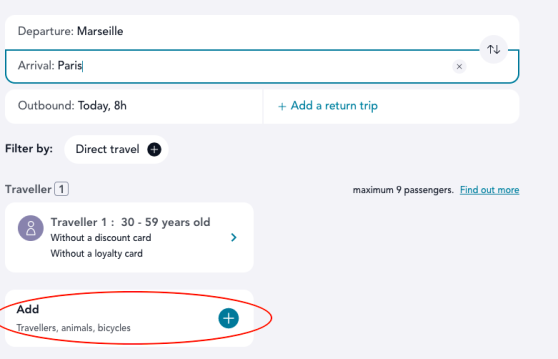
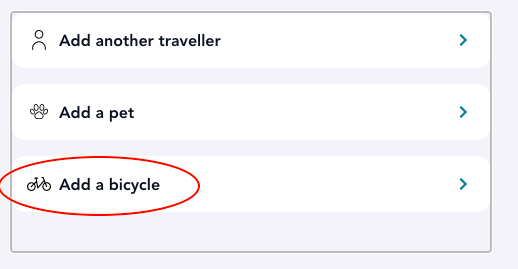
- Then choose your "bike offer" (non-dismantled bicycle – bicycle in a cover, free service...).
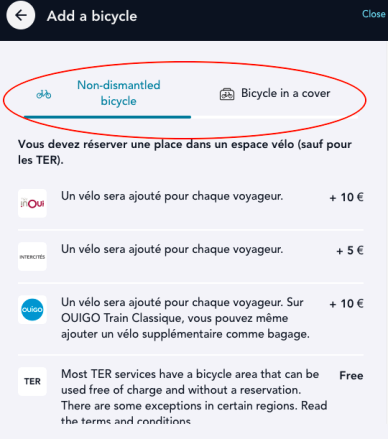
- The number of bikes will automatically be adapted to the number of passengers (2 passengers = 2 bikes).
- Please note: if the search for a ticket with a seat plus bike does not return any results, it means that the train does not have dedicated bicycle space or no more space available.
- Proceed with the booking of your ticket. If you wish to change only your bike seat, you will have to change your entire train ticket + bike ticket booking.
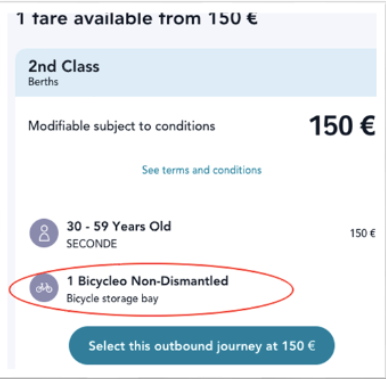
- To make sure that you have booked your train ticket with a bike, check in the travel confirmation whether the bike icon appears.
6. Our tips
- We strongly advise you to download the sncf mobile app prior to departure.
- Arrive 30 minutes early at the train station.
- Ask people - ticket inspectors if they can tell you if there is a lift or easier access to the platforms (sometimes lifts are hidden).
- Avoid peak times (especially for TER trains with free service).
- Never take the last TER (because if it is full, you may be refused access for the bike).
- Locate the train's bike car.
If you have booked luggage transport, your main luggage will be transferred by vehicle, so you will only need to carry daily provisions with you in a day pack. Take plenty of water (at least 1.5-2 litres per person) as well as a hat, sunglasses, sunscreen, rain jacket or windbreaker, warm jacket/fleece, camera, small first aid kit, lunch & snacks.
Take extra water if the weather is particularly windy or hot.
The following is a guide to recommended clothing and equipment for this particular trip, without reference to other activities or travel arrangements you may have planned in Europe.
Maps
You will receive a set of maps that have been created especially for this trip. There is only 1 route marked on each map. The routes have been drawn on the maps as accurately as possible, using GPS tracks obtained while creating the route. However, the maps provided with these route descriptions are intended to be a GENERAL GUIDELINE as they are not of topographic quality. For detailed maps of the area, you may wish to purchase your own maps online (see, for example www.mapsworldwide.com or Cartes IGN - Fédération Française de la Randonnée Pédestre (ffrandonnee.fr). We recommend IGN maps.
Medications
It is your responsibility to bring sufficient quantities of any specific medications you require and carry them in your hand luggage when flying.
Basic First Aid kit
We suggest that you bring:
• Sun cream and lip balm and after -sun cream such as aloe vera.
• Throat lozenges or sweets – a small supply, always welcome when cycling, especially hard caramels, mints or fruit sweets
• Energy: Consider bringing energy drink powder in sachets
• Allergy: Antihistamine medication where necessary
• Antiseptic solution: dettol, betadine in swabs or solution with cotton wool
• Small pack of wet wipes or antibacterial hand gel: very useful for cleaning hands when limited or no water is available
• Treatment for headaches and/or pain relief
• Anti-inflammatory tabs such as Nurofen or Ibuprofen. Arnica for bruising or sprains
• Insect repellent and bite relief
• Nail scissors, needle and thread
• 4" crepe bandage, plus an elastic bandage or ankle/knee support
• Vaseline
IMPORTANT: Airlines do not allow you to take liquids on board in bottles greater than 100ml (some exceptions apply – refer to your airline for details).
All liquids you take on board should be placed in a plastic zip lock bag and offered for inspection by customs.
Pen knives, scissors, nail files and containers larger than100ml cannot be carried in your hand luggage when flying.
Clothing and other items
You will need your regular walking/cycling gear, including some sort of reflective garment. For the evenings, smart outdoor style trousers (or shorts) are invaluable, as are quick-dry t-shirts. These can be washed easily and will dry overnight and still look good for sightseeing or having a drink in town.
Take as little as possible to avoid potentially lugging a heavy suitcase up three flights of stairs at the end of the day. Please be aware that laundromats (“Laverie”) are not common in rural areas, so plan to do handwashing of small items.
Lightweight walking shoes/ trainers
For wearing around towns & villages. They can also be a back-up pair.
Socks & underwear
Take only good quality socks with quick-dry and insulating qualities. Road test them before you go on the trip. Take a suitable quantity of underwear as washing facilities are limited.
Warm jacket, hat, gloves
Bring a fleece, Polartec or warm layers for the evenings especially in spring or autumn; be sure it is totally suitable for your needs.
A fleece jacket which blocks the wind (Wind-stopper) is the most preferable. In the summer months a lightweight jacket is suitable for evenings.
If you are cycling/walking in mountainous or coastal areas, even in the height of summer, the weather can change very quickly and unexpectedly and you should be prepared for fog, mist, rain, snow or hail at any time. Always take an extra layer with you, as well as a warm hat and gloves.
Waterproof jacket & trousers
If you are caught in heavy rain, with good waterproof clothing you should remain dry. Remember that most garments will lose their properties over time. Few will remain waterproof for more than five years and many deteriorate in three years or less. We recommend a rain jacket with a good hood and collar and waterproof or thermal walking/cycling trousers or tights.
Dress code
In general, you should wear suitable clothing when entering a church (in many places, it is considered unacceptable to go inside wearing shorts or a tank-top). We suggest that women carry a shawl to cover up bear shoulders or low-cut tops. It also comes in handy when your shoulders get sunburned!
It is considered inappropriate for men to go without a shirt / T-shirt (other than at the beach).
Toiletries
Bring your own toiletries including soap, comb, toothpaste, toothbrush, etc.
Sewing kit
A sewing kit may be useful.
Snacks
Light, high-energy foods like nuts, dried fruit and chocolate make good energy supplies. If you have specific dietary requirements, you may want to bring along your own supplements. Some specific dietary requirements may not be catered for at your destination.
Reading material, journal, cards
A small paperback or journal may be good for free time in the evening.
Day pack
When walking
It is essential to carry your gear needed each day. A minimum capacity of 25 L is preferable, with a good hip harness.
When cycling
Your hire bike will have a front cycle bag and/or back panniers, to carry the gear you’ll need each day. Please be aware that rental bike suppliers do not supply bicycle mirrors and seat gels. If you usually cycle with these, we recommend you bring them with you.
Day pack for walking and cycling:
• Your accommodation list
• Your maps and route notes
• Fully charged and working phone
• Powerbank and its charging cable
• First aid kit
• Water bottle
• Lunch box (Tupperware container), knife, spoon and cup (or something to drink from)
• Waterproofs
• Warm layers
• Warm Hat and Sun Hat
• Lightweight Gloves (for Spring or Autumn)
• Small Towel
• Sun cream
• Sunglasses
• Camera, batteries for camera and a spare memory stick
Clothing & other items for walking
Trekking poles (adjustable)
Highly recommended. A pair works best, depending on what you are comfortable with. If you suffer from back or knee pain this should be considered essential. Remember to practise walking with your pole(s) on different types of terrain in the months preceding your trip.
Walking boots
The importance of good footwear cannot be stressed enough. Your boots should be sturdy and of good enough quality to handle all types of terrain. Lightweight boots, (cordura/leather boots) which have Gore-Tex or sympatex water-proofing are most suitable for this trip. They should provide good ankle protection and be well broken in. Waxing leather boots regularly prolongs their life.
Walking tops & trousers
We recommend walking trousers and shorts and quick-dry wicking t-shirts. These can be washed easily and will dry overnight and still look good for sightseeing or having a drink in town. Wicking T-shirts are fast drying, keep moisture away from your skin and are available at outdoor stores. You should also bring one pair of loose-fitting trousers to wear in cities and for evenings out, etc. Shorts or zip-off trousers are useful in warmer weather.
Compass
You will probably also have this option on your phone. A compass shows you the cardinal directions used for navigation and geographic orientation. If you are lost, this will help you navigate in the right direction.
Luggage Transfer
If you have booked luggage transfer, this service is provided either by the accommodation itself or by a local transport company (often a taxi driver).
All luggage must be clearly labelled with the name of the main booker on a luggage tag.
Luggage without a tag will not be transported.
Labelling your luggage correctly helps prevent mix-ups, delays and loss.
If you have not received luggage tags from your agency, please bring your own.
Please clearly indicate how many pieces of luggage belong to the main booker, so the person in charge of the transfer knows how many bags must be collected and delivered.
For example:
- Group of four people with one bag each: 1/4 – 2/4 – 3/4 – 4/4
- Solo traveller with one bag: 1/1
Each morning, ask the hotel staff where your luggage should be left.
Luggage must be ready by 09:00.
Other rules apply for the Camino and Mont Blanc trips.
In the afternoon, your luggage will normally be delivered to your next accommodation before 18:00, and in most cases before 17:00.
We strongly recommend carrying a small day-pack with essentials such as a change of clothes, swimwear and medication, in case you need them before your main luggage arrives.
General Luggage Rules
- Only 1 piece of luggage per person is included
- Maximum weight: 15–20 kg (please check your travel documents)
- Maximum size: 65 × 40 × 30 cm
If you are travelling with more than one piece of luggage, this must be mentioned at the time of booking. A supplement will apply.
If your luggage exceeds the size or weight limits, a significant surcharge may apply.
Unlabelled luggage will not be transported.
Special Rules for Certain Trips
Camino trips
- Maximum: 1 suitcase or travel bag (13 kg).
- Additional bags or bags exceeding 13 kg may not be transported
- Do not attach items to your main bag, as these may be lost or damaged
- Any differences will be mentioned in your trip information.
If excess luggage is found locally and there is space in the vehicle, the driver may choose to transport it.
In that case, you will receive a payment link by email to pay the supplement by credit card.
If payment is not made immediately, the luggage will not be transferred.
Tour du Mont Blanc trips
- Maximum: 1 suitcase or travel bag (15 kg).
- Any differences will be mentioned in your trip information.
Additional Information
If you are unable to cycle or walk on a given day, you may ask the person in charge of luggage transfer whether it is possible to ride along with the luggage.
This is not always possible and may require a local supplement.
Please note:
- The vehicle may not be suitable for passengers
- The transporter may not have the required insurance or permit
- If applicable, ask in advance about the transport of your bike as well
When travelling by public transport, you must always take your luggage with you.
Using Your Own Bike
If you prefer to travel with your own bike, please note the following recommendations:
- Have your bike fully serviced by a qualified mechanic before departure.
- Fit anti-puncture tyres and, where possible, tyres with a reflective side strip to improve side visibility.
- Check that your travel or cycling insurance covers your bike for loss, theft and damage both in transit and during the tour.
- Carry a basic repair kit (inner tubes, tyre levers, multi-tool) as our suppliers' support services are designed for rental bikes.
Please note that neither we nor our suppliers accept responsibility for personally-owned bikes during the tour.
Pre-Departure Bike Check (rental bike or your own bike)
Before you set off, we recommend taking a few minutes to check your bike is ready for the next day:
- Battery: If you are using an e-bike, ensure your battery is fully charged. We recommend charging the battery every evening — range will vary depending on terrain, riding style and assistance level selected. Carry the charger adapter in your bag in case you need a top-up during the day.
- Tyres: Check that both tyres are properly inflated.
- Brakes: Test both brakes to confirm they engage firmly.
- Lights: Check that front and rear lights are working, especially if you may be riding in low-light conditions.
- Check: Inspect the bike for loose or broken parts.
- Accessories: Confirm you have everything you need — lock, repair kit, any bags or panniers.
Your rental bike will typically be found in your accommodation's bike storage area. Please check at reception.
If you have any questions about operating your e-bike — including battery, motor assistance settings or any other functionality — please contact the supplier directly in the first instance. Their contact details are included in your trip documents.
Equipment
If you have any questions about the equipment required for this trip, please contact us. We recommend buying your equipment at a reputable bike or outdoor sports shop, where you can also get professional advice.
Rental Bikes
You will be provided with:
- A cycling helmet (unless specified at booking that you are bringing your own)
- Lock
- Pump
- Spare inner tube
- Puncture repair kit
Please bring with you:
- Phone holder
- Hi-visibility jacket
- You may choose to bring your own gel seat cover for added comfort.
- Cycling glasses (to protect against dust, insects, pollen, sun, etc.)
- Cycling gloves (padded for extra comfort)
- Reusable water bottle or water delivery system (e.g. camelbak or platypus)
- Rental bikes are fitted with standard flat pedals. SPD (click-in) pedals are available on some trips on request — please let us know before booking if you would like these or are bringing your own.
If You Are Travelling with Your Own Bike
Don't forget to bring:
- Helmet
- Puncture repair kit
- Phone holder
- Hi-visibility jacket
- Cycling glasses (to protect against dust, insects, pollen, sun, etc.)
- Cycling gloves (padded for extra comfort)
- Reusable water bottle or water delivery system (e.g. camelbak or platypus)
Clothing
- Brightly coloured, quick-dry fabrics are ideal — they keep you visible, comfortable and dry throughout the day.
- For riding, we recommend padded shorts or cycling tights, a wicking T-shirt with a collar for sun protection, and at least one long-sleeved top.
- A waterproof cycling jacket is strongly recommended.
- A light windproof layer is always worth packing even on warm days.
- For sightseeing stops, quick-dry loose-fitting trousers are practical and versatile. Zip-off trousers are a popular choice as they double up for both cycling and walking around towns and villages.
Footwear
- Stiff-soled shoes are best for cycling, as they transfer pedal power more efficiently and reduce fatigue — this matters more the longer and more demanding your daily route.
- If you are bringing clipless cycling shoes with SPD cleats, bear in mind that protruding cleats are not well suited to a touring holiday that involves walking around cobbled streets or visiting churches and restaurants. A second pair of comfortable shoes, trainers or sandals for off-bike time is well worth the extra space in your bag.
- Whatever footwear you choose, keep laces short — tuck the ends into your shoe or sock to prevent them catching in the chain or spokes.
Safety
General
- Use common sense and caution at all times. Always keep an eye open for potentially dangerous situations (difficult terrain, sheer drops, changing weather conditions, etc.).
- Always keep an eye open for pedestrians and beware of car doors, as sometimes people open them without looking out for cyclists.
- At crossroads, look at drivers and attempt to establish eye contact.
- Avoid cycling at night or use lights, and remember to put on your high-visibility jacket.
Riding on the Right
- In France, traffic travels on the right-hand side of the road.
- Always ride on the right, and remain especially vigilant at junctions, crossroads and when crossing major roads. This is easy to forget after a long stretch of quiet countryside cycling — particularly if you are accustomed to driving or cycling on the left.
- At intersections, approach slowly, check carefully for traffic coming from your left, and if in doubt, dismount and use the nearest pedestrian crossing.
Braking Technique
- Apply both brakes at the same time gently, never stab at them. On downhill sections, use both brakes to slow down before entering a curve.
- Do not apply brakes continuously, as they could overheat and stop working.
- Beware of rain and wet roads: water on the rims could affect your brake system, making it harder to stop. Apply the brakes lightly to clean off and dry the rims BEFORE you need to stop and allow a greater distance when stopping in wet conditions.
These conditions apply to all bike rentals arranged through us as part of your self-guided tour. The bike and equipment are supplied by one of our local hire partners ("the supplier"). By accepting a rental, you agree to the conditions below. You may also be asked to sign a supplementary agreement specific to the supplier at the point of collection.
The supplier is committed to providing you with well-maintained, roadworthy equipment and will support you promptly in the event of a mechanical issue.
1. Equipment & Ownership
The bike and all accessories (lock, helmet if provided, bags, etc.) remain the property of the supplier throughout the rental period. The renter may not sell, sublet, lend or otherwise transfer the equipment to any third party.
2. Condition & Pre-Departure Check
Before setting off, you must inspect the bike and all accessories and confirm they are in good working order. Any damage, defect or missing item must be reported to the supplier immediately — before the rental begins. By starting your trip, you confirm that the equipment was received in satisfactory condition.
3. Proper Use
You agree to use the equipment responsibly and in accordance with all applicable laws. In particular, you must not:
- ride under the influence of alcohol or drugs
- use the bike off-road or on terrain for which it was not intended
- carry passengers unless the bike is specifically designed to do so
- exceed any weight limit specified by the supplier
- allow any other person to use the bike without the supplier's prior agreement
You must ride with due care and attention for your own safety and the safety of others.
Section 3a — Electric Bikes
Where the rental equipment includes an electric bike, the following additional conditions apply:
Battery Care
You are responsible for charging the battery using only the charger provided and in accordance with the supplier's instructions. The battery must be charged in a dry, ventilated indoor space — never outdoors, in direct sunlight, or near flammable materials.
Damage to the Battery
E-bike batteries are high-value components. Any damage resulting from improper charging, use of an incorrect charger, impact, immersion in water, or failure to follow the supplier's instructions may result in you being held liable for the cost of repair or replacement. Battery replacement costs typically range from €400 to €900 depending on the model.
Range & Performance
Battery range will vary depending on terrain, riding style, weather conditions and the level of motor assistance selected. We recommend charging the battery each evening, even if not fully depleted.
Reporting Faults
If you notice any unusual behaviour — including excessive heat, failure to charge, or unexpected loss of range — stop using the bike immediately and contact the supplier. Do not attempt to repair or open the battery unit yourself.
4. Helmets & High Visibility Jackets
Under French law, wearing a helmet is compulsory for children under 12 years of age (whether riding or travelling as a passenger). For riders aged 12 and over, helmets are not currently required by law, but are strongly recommended. We encourage all riders to wear a helmet throughout their tour.
Under French law, high-visibility jackets are compulsory when riding at night or in low visibility conditions.
5. Security
The bike must be secured with the lock provided whenever it is not in use — including overnight at your accommodation. Always lock the frame (not just the wheel) to a fixed, immovable object.
6. Reporting Breakdowns, Theft or Loss
In the event of a breakdown, theft, loss or accident, you must contact the supplier as soon as possible. Contact details will be provided in your trip documents. Please also retain any police report or reference number, as this may be required in the event of a claim.
In the case of a mechanical failure that is not the result of misuse, the supplier will arrange repair or replacement as quickly as reasonably possible.
7. Damage & Liability
7.1 Your Responsibility
You are responsible for taking care of the bike and all accessories throughout the rental period. The supplier may charge for damage resulting from misuse, negligence, or failure to follow these conditions.
Bicycle touring involves varying terrain and conditions. You are responsible for riding within your own ability, following road regulations, and exercising appropriate caution at all times. Neither we nor the supplier can accept liability for injury or loss resulting from your own actions or decisions while cycling.
7.2 Theft, Loss or Serious Damage
In the event of theft, loss or damage beyond economic repair, the supplier may hold you liable for the replacement value of the equipment. Replacement values typically range from €650 to €3,500 depending on the type and model of bike.
7.3 Insurance
We strongly recommend that you check whether your travel insurance policy covers:
- accidental damage to a hired bicycle
- theft of a hired bicycle
- personal accident and medical costs
- third-party liability while cycling
7.4 Limitation of Liability
The supplier is not liable for any damage, injury or loss resulting from improper use of the equipment, failure to follow these conditions, or circumstances beyond the supplier's reasonable control.
8. Return of Equipment
The bike and all accessories must be returned to the agreed location by the agreed time, in the same condition as received.
Late Return
If the bike(s) is/are not returned by the return time stated in the booking confirmation, rental charges will continue to accrue, plus a late-return fee of €25 per day. We also reserve the right to claim reimbursement for any additional costs or losses caused by the late return.
9. Age Requirements
Bikes may only be rented to persons aged 18 or over.
Rental to persons under 18 is subject to prior written authorisation from a parent or legal guardian and the express agreement of the supplier. This authorisation must be arranged before the rental begins. The supplier does not accept liability for minors during the rental period; responsibility rests with the parent or guardian.
10. Governing Law
These conditions are governed by French Law. Any disputes arising from the rental agreement shall be subject to the jurisdiction of the courts in France.
Questions? If you are unsure about any of these conditions before or during your trip, please contact us directly — we're here to help.
Self-guided walking has its inherent risks. It is a sport where safety depends upon the judgement and alertness of each participant.
S-Cape is concerned about client safety and we go to great lengths to provide correct, detailed and up-to-date information in our route descriptions.
It is very important for each participant to be conscious of his/her responsibility to heed the information given in our route descriptions and apply these, USING COMMON SENSE.
When out walking, you are responsible for the way you act and the decisions you make. At times this may involve walking on a varied terrain (uneven surfaces, wet/muddy/slippery sections, loose rock, poor visibility, etc.) that can present difficulties and challenges that should not be underestimated. In these situations, it is of utmost importance that the participant uses a great deal of caution and common sense as some routes can become dangerous and unsafe if the person has not taken sufficient care, is not dressed appropriately and does not have adequate physical and/or technical ability.
The walking routes on this programme follow official paths. On these routes there are places where the path crosses a stream (or dry streambed). You will often NOT find bridges, since these are streams which you can walk across with your boots on or by using stepping stones. In spring and autumn, the depth of some streams may increase and you may have to take your boots off and wade across (through ankle-deep or slightly higher water). We would NOT recommend wading across when water levels are above the knee!
Stepping stones can be slippery so pay special attention when crossing and use your trekking poles for balance. It is best to walk on the stream bed rather than on top of the stones especially if they are wet, mossy or muddy.
Safety
Use common sense and caution at all times.
Always keep an eye open for potentially dangerous situations (difficult terrain, wet surfaces, sheer drops, changing weather conditions, etc.).
Signs & signals
Obey all signs and recommendations along the walking routes.
Intersections
Although this trip mainly follows walking paths, with occasional sections on rural tracks or quiet country roads, you will inevitably have to cross some major roads with traffic.
If you are used to walking on the left-hand side of the road, please remember please remember that in France traffic will be approaching on the RIGHT-HAND side of the road, so be extra careful when crossing roads and at junctions. This may be easy to forget after a long section on your own in the countryside.
Crossing streams
Usually you should be able to walk across easily. However in spring and autumn, the depth of some streams may increase and you may have to take your boots off to wade across (through ankle-deep or slightly higher water). Never attempt to cross a stream where the water comes above your knees.
For all our cycling & walking trips we use the GUIBO APP (iOS and Android). It provides detailed maps and tracks to help you follow your route, and shows your exact position using your phone's GPS.
The app also helps you navigate from the end of your route to your hotel. This feature requires an internet connection, so we recommend enabling data roaming during your trip.
Download the GUIBO Travel App Manual (PDF)
Please watch our 8-minute instruction video
It shows you how to download the app, use it for navigation, and make the most of its features. If you follow the instructions and tips, the app will function smoothly on your device.
This travel programme has been compiled with great care and precision. However, it is possible that you may experience small changes during your holiday, or notice errors unforeseen at the time of writing. The information is provided “as is” and we accept no responsibility for any loss, injury or inconvenience experienced as a result of this information.
If you notice any errors, please let us know. We greatly appreciate any suggestions, observations or comments you might have, and you may be certain that they will be used for the benefit of future travellers.
Also, do not hesitate to share your experience with your family & friends!
Thank you in advance for your cooperation.
Team S-Cape Partners France